
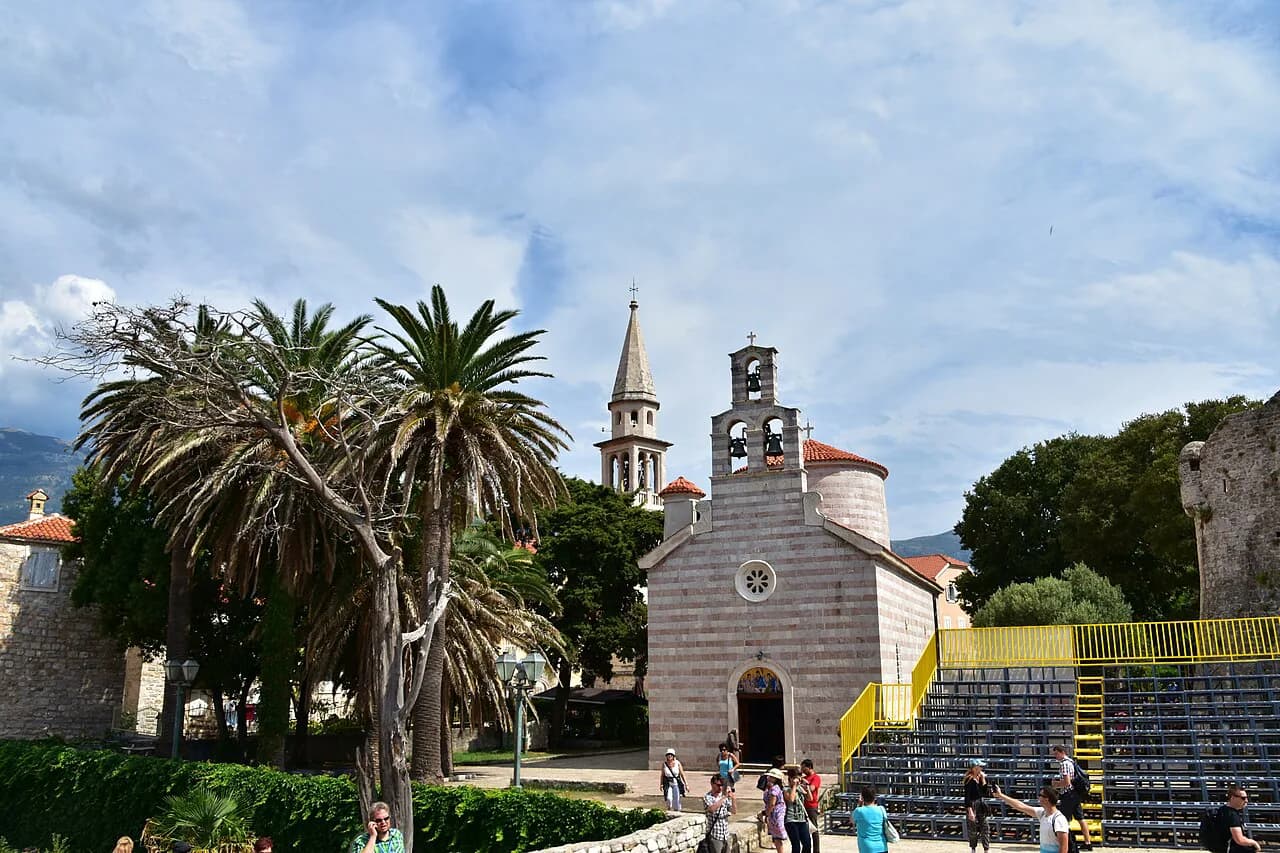
Holy Trinity Church, Budva: Visiting the Old Town's Orthodox Church

Holy Trinity Church is an Orthodox church tucked into Budva's Old Town, set beside the ramparts and the Citadel on the western side. Allow 15 to 20 minutes: enough to read the facade, step inside for the iconostasis and pause at the tombstone outside. This guide covers where the church sits, how to reach it on foot, what to look for outside and in, and which sights are immediately next to it.
Where Holy Trinity Church is in Budva Old Town
The church occupies a narrow strip of land within the Old Town, next to the ramparts and the Citadel on the west side, according to Adria Line's description of the building. Another account places it opposite the Archaeological Museum on Starogradska Square, which is the useful landmark if you are navigating by the town's open spaces rather than the walls. Either way, you are looking at the western edge of the walled town, not the seafront or the newer streets beyond the gates.
Treat the church as part of an Old Town walk rather than a separate outing. Budva's walled centre is compact and lanes bend sharply, so a landmark reference such as the Citadel or the museum saves time. If you want the wider set of sights in the old centre laid out for planning, our Budva Attractions guide covers the options.

Getting there on foot
You reach Holy Trinity Church on foot from anywhere inside the Old Town in a few minutes, following lanes towards the Citadel and the western ramparts. From the surrounding streets outside the walls, enter through the Old Town gates and keep heading west; the church sits low against the defences rather than on a prominent square of its own. No transport is needed once you are in the centre.
The practical point is to combine the visit with the defences themselves. The Citadela Budva occupies the same western corner, so you can see the church and then continue onto the fortress without retracing your steps.

Construction: Austrian permission and the 1804 completion
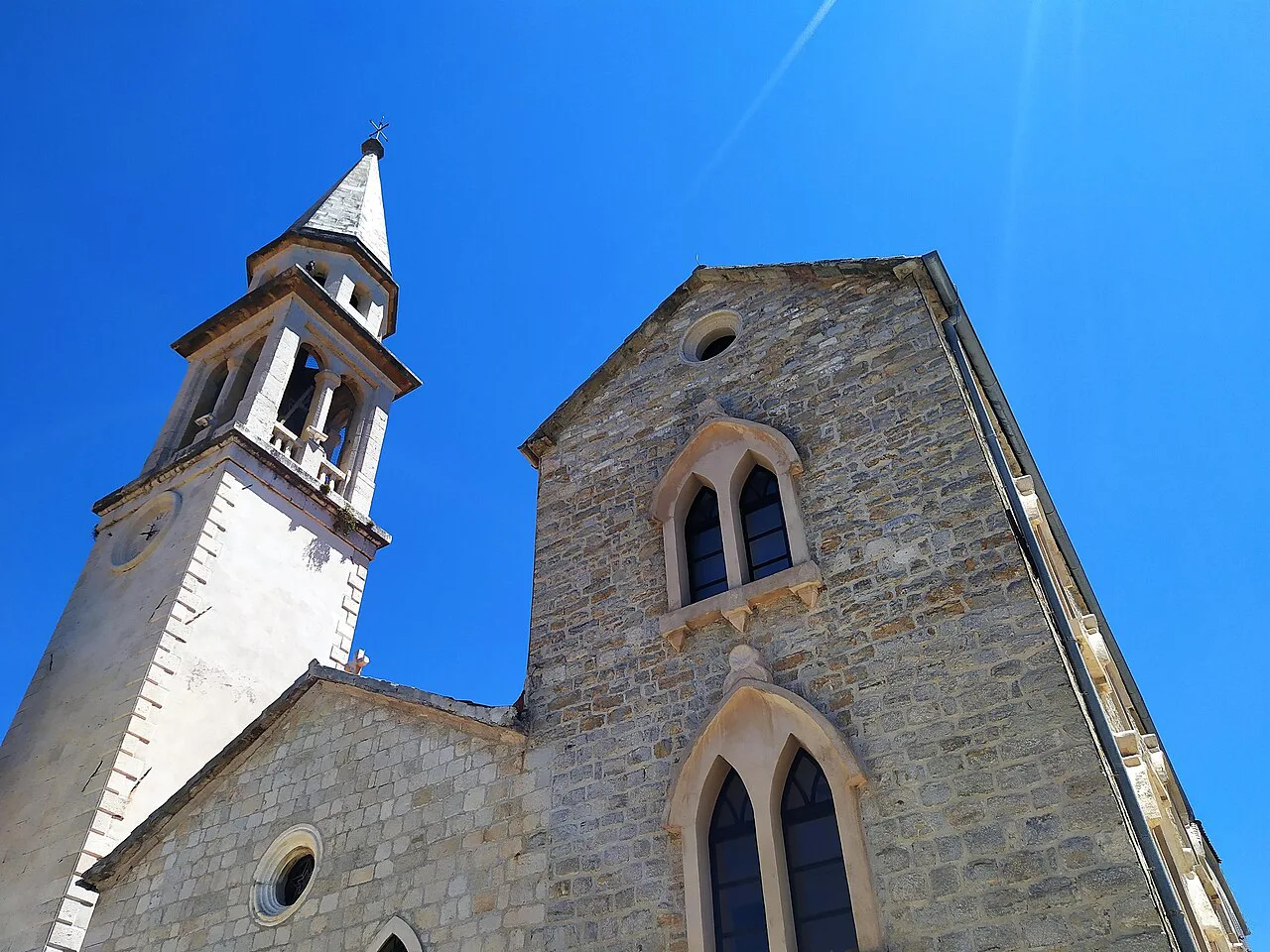
Adria Line records that after the fall of the Venetian Republic in 1797, Austria permitted construction of the Church of Holy Trinity at the request of Budva's Orthodox population, supported by the Bishop of Montenegro, and that building finished in 1804. Another account gives the construction period as 1798 to 1904, which conflicts with the 1804 completion date. The exact chronology is unsettled, and the church's own history should be read with that conflict in mind rather than used for planning.
Event in Montenegro adds that the church was built in the manner of the Church of the Holy Dormition of the Virgin at the Monastery of Subostrog, with bands of white and red stone laid along its walls, and describes the overall style as Byzantine. This is the sort of detail worth carrying with you: look at the colour banding in the stonework before you go in.
What to see on the outside
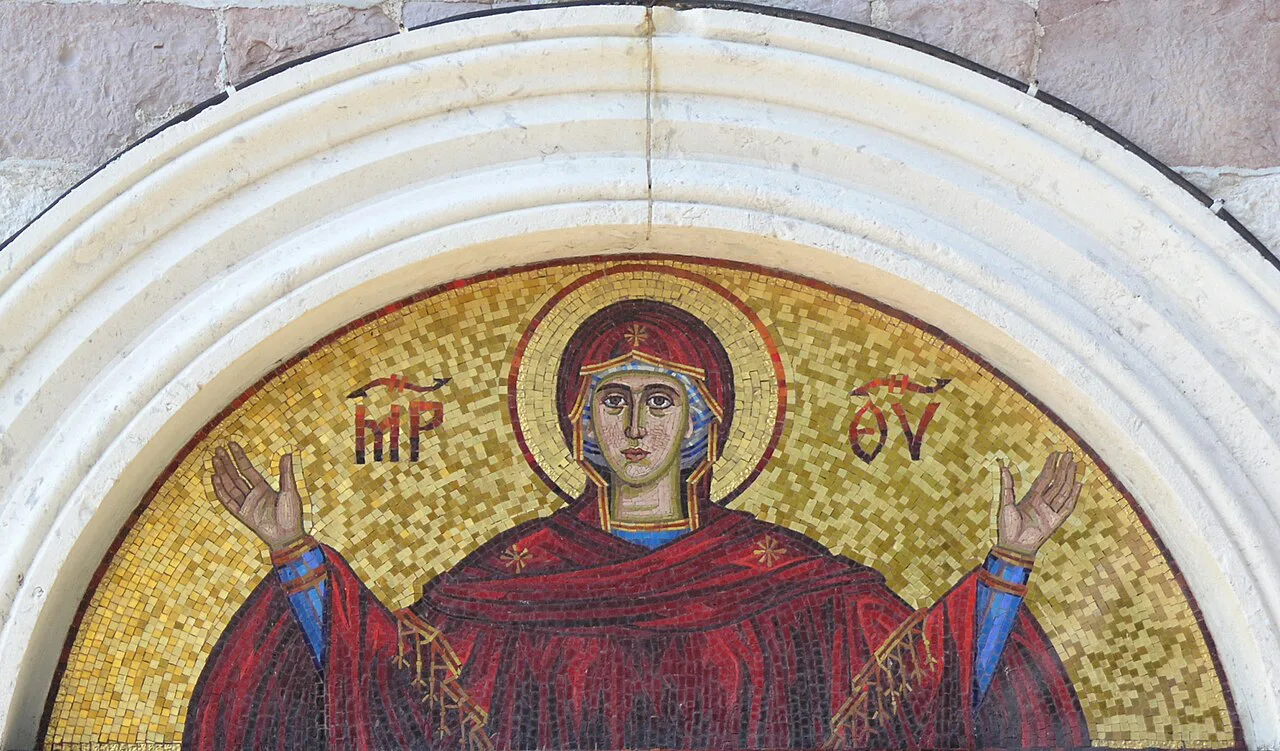
The facade gives you three things to look up for. Adria Line lists a bell loft holding three bells, a dome, and a rosette set above the western door. From the lane, the bell loft and dome read against the sky, while the rosette needs a closer look from directly in front of the entrance.
In front of the church stands the tombstone of Stefan Mitrov Ljubiša, the Budva-born author and politician, as Adria Line describes it. It is easy to walk past while watching the doorway, so look at the ground immediately outside the facade before entering.
Inside: the iconostasis
The interior feature to seek out is the iconostasis, the screen of icons that separates the nave from the sanctuary. Adria Line describes it as the work of Greek iconographers of the 19th century and rates it highly for its artistic value. Event in Montenegro is more specific, naming the Greek icon painter Naum Zetiri, from the island of Milos, as the painter of the tall iconostasis in 1833; treat the name as that account's attribution rather than settled fact.
Give the screen a slow look rather than a glance from the door. It rewards attention to individual panels and the order in which figures are arranged, and it is the main reason to step inside rather than simply photograph the exterior. Event in Montenegro also notes the church was damaged in the 1979 earthquake and reopened after restoration, which explains the condition of the fittings you see.
If you want to compare this church with Budva's other religious buildings, Santa Maria in Punta Budva is a separate stop in the old centre with its own character.
How long to allow and when to go
Fifteen to 20 minutes covers the facade, the tombstone and a proper look at the iconostasis. Add another ten if you want to sit quietly, since this is a working Orthodox temple rather than a museum room. That keeps the church in proportion inside a half-day Old Town walk.
Old Town lanes are narrow, and the church sits in a confined space by the ramparts, so a large group can crowd the entrance. Many visitors find the early morning or late afternoon quieter, but no source gives peak times. If you are building a fuller day around the old centre, the wider list of things to do in Budva helps you sequence the stops.
Nearby: Citadel, museum and Starogradska Square
The Citadel is the obvious next stop, sharing the same western corner of the walls. The Archaeological Museum, cited as the landmark opposite the church, sits within the Old Town as well, so the three make a natural sequence without leaving the walls. Starogradska Square gives you an open space to orient yourself before or after the church.
Two other religious sites sit within reach if you are tracing Budva's churches. The Church of Saint Sava (Crkva Svetog Save), Budva is a separate Old Town church, and Podmaine Monastery, Budva lies outside the walls for a longer excursion. Mogren Fortress, Budva is the coastal viewpoint option if you want to end the day looking out to sea.
Dress and etiquette at a working Orthodox church
Event in Montenegro describes Holy Trinity as an Orthodox working temple, so behave as you would in any parish church in use. Cover shoulders and knees, keep voices low, and avoid walking across the space in front of the iconostasis during prayer. Photography without flash is the safer default unless you see a notice saying otherwise.
If a service is under way, stand near the back or wait outside rather than moving around the nave. The church is small, so a handful of worshippers changes the atmosphere quickly. This is also why the visit works best as a quiet stop inside a longer walk rather than a scheduled attraction on a ticketed circuit.
What to check before you go
No opening hours, entry price or service times for Holy Trinity Church appear in the sources used here. Confirm current opening hours and any service times locally, at the Old Town tourist information point or with your accommodation, before making the church the first stop of your day. The rest of the visit, from the facade to the iconostasis, involves no booking, but that is not the same as confirmed entry.
Should Holy Trinity Church be on your Old Town walk?
Yes, as a short stop rather than a destination in itself. Fifteen to 20 minutes buys you the bell loft and rosette outside, the tombstone of Stefan Mitrov Ljubiša at the door, and the 19th-century iconostasis inside, and you are already beside the Citadel and the museum when you finish.
Pair it with the walls and the Citadel, keep the visit quiet and appropriately dressed, and check opening times locally on the day. If you are still mapping the old centre, the Budva Attractions guide sets out the surrounding sights.
Frequently Asked Questions
Is Holy Trinity Church in Budva Catholic or Orthodox?
It is an Orthodox church, built at the request of Budva's Orthodox population and described as a working Orthodox temple. The construction account links its permission to Austrian rule after the Venetian Republic fell in 1797, with the Bishop of Montenegro supporting the request.
Do you have to pay to go inside Holy Trinity Church in Budva?
No entry price for the church appears in the accounts used for this guide. Confirm any current entry arrangements or donation practice on the spot when you arrive, since published visitor information does not state them.
Can you visit Holy Trinity Church during a service?
It is a working parish church, so worship takes priority over sightseeing. If a service is in progress, stay near the back or wait outside, and keep the visit quiet and brief so you do not disturb the congregation.
How long does a visit to Holy Trinity Church take?
Fifteen to 20 minutes is enough to look at the facade, the bell loft and rosette, read the tombstone outside and give the iconostasis a proper look. Add a little time if you want to sit quietly, and allow longer for the Citadel next door.