
Španjola Fortress (Tvrđava Španjola), Herceg Novi: What to See and How to Get There

Španjola fortress is a free, unrestored ruin on the hill directly above Herceg Novi's centre, and the climb is the price you pay instead of a ticket. Allow roughly an hour including the walk up and the views, and treat it as a rough-edged historic site rather than a managed attraction with displays. This guide covers where the fortress sits, how to reach it on foot or by taxi, what survives inside the walls and how it fits alongside the town's two lower fortresses.
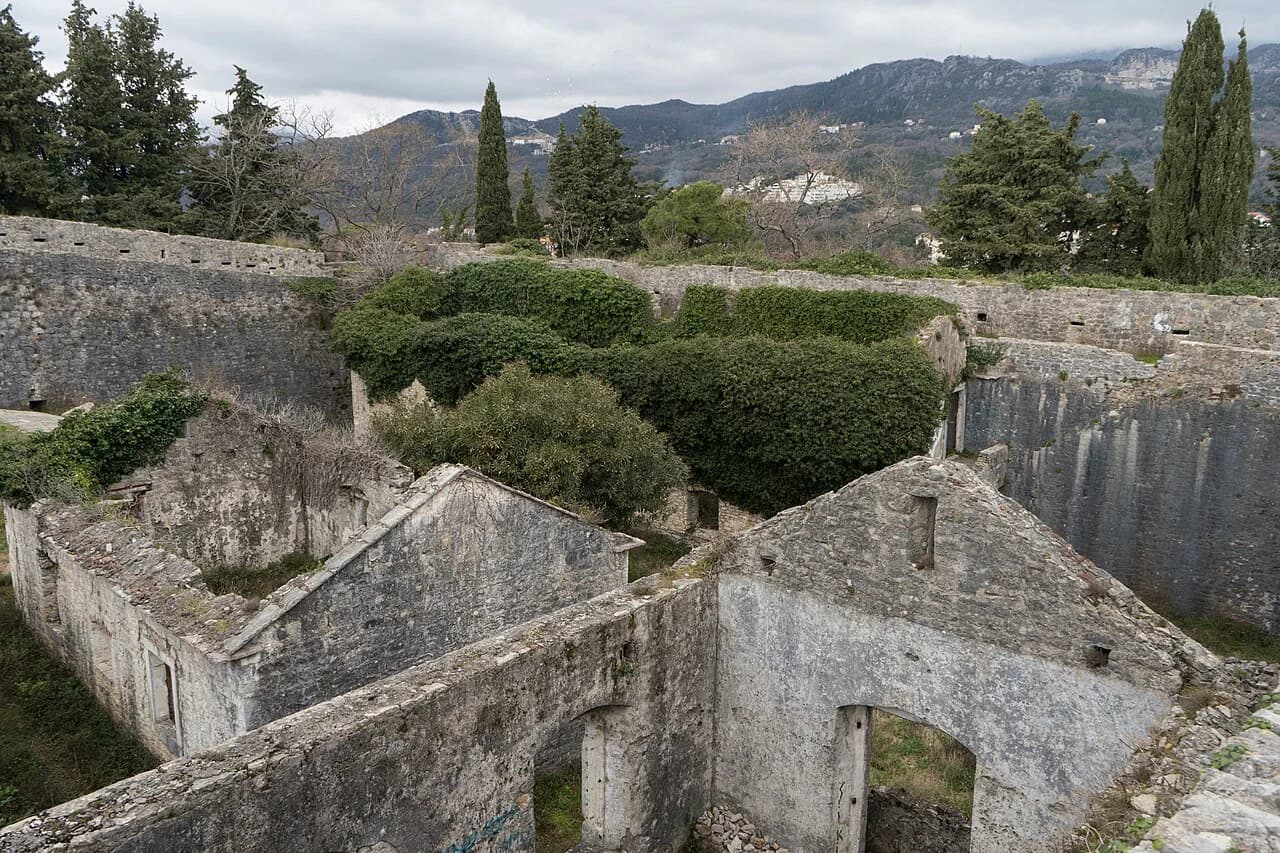
The fortress is also called Tvrđava Španjola or the Spanish Fortress, and its present shape dates from the short period of Spanish rule in the mid-sixteenth century. It was later used as a prison, and the interior has not been restored or fitted out for visitors.
Where Španjola sits above Herceg Novi
Španjola stands on a hill above the town centre of Herceg Novi, high enough that it looks down on the whole town and a large stretch of the Bay of Kotor, also called Boka Kotorska. From its walls you can pick out the two lower fortresses, Kanli Kula and Forte Mare, which sit closer to the water. That elevated position is exactly why the site feels removed from the bustle of the seafront.
Plan the fortress as the upper point of a walk that also takes in the lower defences rather than as a standalone outing. The town's fortifications layer from the shoreline upwards, so the natural order is Forte Mare by the water, Kanli Kula on its terrace, then Španjola at the top.
The site's future is a planned reconstruction as a creative centre led by the Ministry of Culture, with exhibition space, artist accommodation and a summer stage proposed. In 2024 the ministry said the tender for the first phase was expected between April and June, with work starting in the autumn. None of those facilities exists yet, so do not plan around them.

Getting there on foot: the climb is the constraint
Walking is the simplest way up, but the ascent is the part that decides whether Španjola suits your day. The route climbs steadily from the centre, and no buses run to the fortress, so anyone relying on public transport still finishes on foot. Wear shoes with grip, because the surface inside the walls is uneven and unkempt.
Do the climb early in the day or late in the afternoon in summer, when the exposed path is out of the strongest sun, and carry water for the ascent. The gradient is the main reason to skip the fortress if anyone in your group struggles with hills.
The path is not a formal visitor route with signage, so allow for a little searching near the top rather than expecting an obvious entrance. Take the lower fortresses first if you want a gentler introduction to the town's defences, then decide whether to continue up.

Taking a taxi up instead
If the hill sounds like too much, a taxi to the fortress is the practical alternative, and drivers in Herceg Novi know the site. The fare quoted for the short trip from the centre is around four euros, which is a guide rather than a fixed tariff, so confirm the figure with the driver before setting off.
Many visitors take a taxi up and walk back down, which gives you the view without the hardest part of the climb. The descent still passes over rough ground near the walls, so keep that in mind if you are nursing an injury.
What you see inside the walls
The fortress keeps four large bastions, one at each corner of the perimeter, and they are the feature to look for as you walk round the circuit. The walls enclose a substantial, largely empty space rather than a built-up interior, which is why the visit is short.
Beyond the bastions, expect weathered stonework, ruined sections and vegetation rather than interpretive panels or restored rooms, and the site is not tidied up for visitors. The fortress once held a water source and a bakery and was known as the Upper Town, but little of that fabric reads clearly today. Bring a torch if you want to peer into shaded corners.
Treat the fortress as a place to look out from rather than a museum to work through, and the hour passes quickly. Photography is the main draw: the ruined walls frame the bay well, especially in low light.
The view over the town and the bay
The panorama is the reason most people make the climb. From the walls you see the whole of Herceg Novi spread below, both Kanli Kula and Forte Mare, and a broad sweep of the Bay of Kotor towards the entrance of Boka Kotorska.
Because the fortress faces the water, the best light on the bay falls across the middle of the day, while late afternoon turns the town below into shadow. If photographs matter, pick your timing on that basis rather than on opening times, since no visiting hours are published for the site.
How long to allow, and whether it suits a short stop
Budget about an hour in total: the walk up, a circuit of the bastions and time at the viewpoint. Add more if you are stopping often for photographs or descending slowly on rough ground.
Španjola fits a short stop well, but it does not fill an afternoon. Pair it with the old town and the seafront rather than building a day around it, and drop it first if your time in Herceg Novi is tight and the climb is unwelcome.
Free entry and the state of the site
There is no ticket and no charge to enter, which reflects what Španjola is: an abandoned, partly overgrown ruin rather than a maintained monument. The gate is not staffed, and nothing is set up for visitors once you are inside.
Check locally before making a special trip, because the reconstruction project could change access at any stage. Ask at the tourist information point in town about the current state of the site and the best route up.
Nearby in Herceg Novi
Come down from Španjola and the town's other sights are within easy reach. Belavista square is a natural pause in the old town, with cafés around it for a drink after the descent, and the seafront promenade runs from there along the water.
Forte Mare sits by the sea and hosts plays and concerts, unlike Španjola, and Kanli Kula is also used for performances, so both make livelier stops if you want something happening. Further along the coast, Savina Monastery offers a quieter change of pace.
For the rest of the town's fortresses and sights, with the practical detail on each, the Herceg Novi attractions guide pulls the options into one place so you can sequence them against the climb to Španjola.
Walk up or take a taxi to Španjola?
Walk if you are comfortable on a steady climb and want the fortress as part of a day moving up through the town's defences; take a taxi up, at the approximate fare quoted for the short trip, if the hill would otherwise keep you away. Either way, go for the view and the four corner bastions, and leave room for the lower fortresses on the way down.
Go with modest expectations of the site itself and high ones for the panorama, and Španjola rewards the effort. Ask in town about access before you set out, particularly while reconstruction is still at the planning stage.