
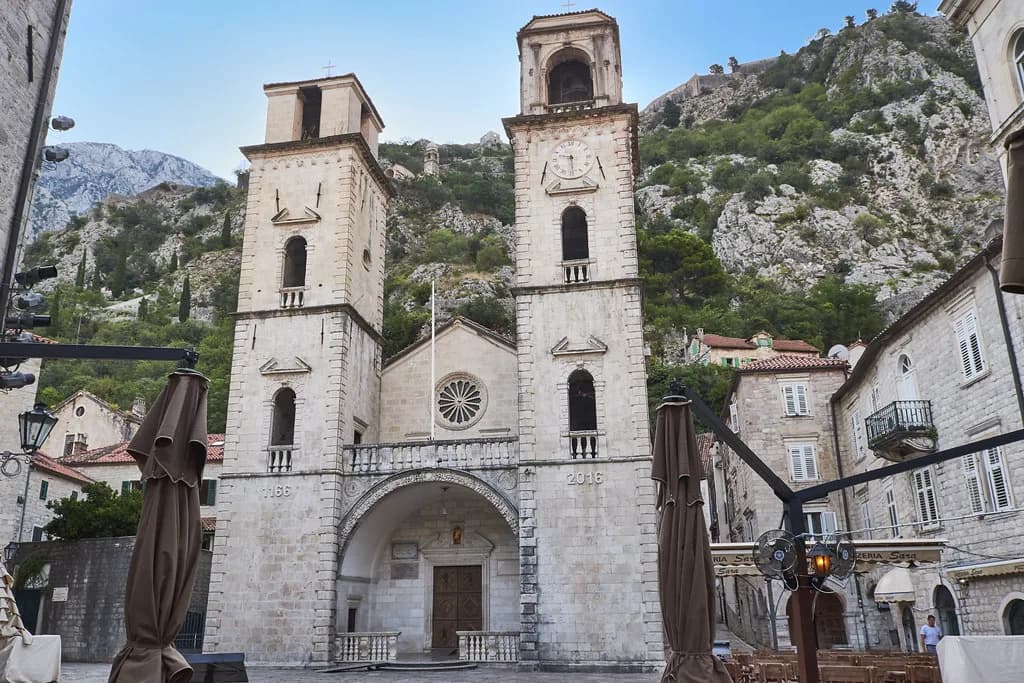
St Tryphon's Cathedral (Katedrala Svetog Tripuna), Kotor
St Tryphon's Cathedral, or Katedrala Svetog Tripuna, is the Roman Catholic cathedral of Kotor and its most famous landmark in the old town. It sits on Trg Sv. Tripuna, a small square inside the walls, and a modest cash fee at the door covers both the church interior and its museum of sacral art. Allow 30 to 45 minutes, or an hour if you read every label in the treasury.
This page covers the cathedral alone: where it stands, what the façade and the two mismatched towers are about, what is inside, the covered-shoulders rule, and the handful of neighbouring churches and squares worth pairing with it. Kotor's wider sights are covered in the Kotor attractions guide, and Kotor Fortress above the town is a separate outing with its own ticket.
What St Tryphon's Cathedral is and why it anchors the old town
The cathedral is the seat of the Roman Catholic Diocese of Kotor and part of the UNESCO listing for the Natural and Culturo-Historical Region of Kotor. The present building was largely completed and consecrated on 19 June 1166, replacing a church from 809 built to hold the relics of Saint Tryphon, the city's patron. Saint Tryphon is a third-century martyr venerated in both Catholic and Orthodox traditions.
Its importance to a visitor is architectural as much as religious. The core is Romanesque, with elements of Byzantine architecture and later Gothic additions, and visible Renaissance and Baroque layers; the west façade was restored in 2009 after the 1979 earthquake. In 2002 the cathedral received a Europa Nostra diploma for its reconstruction and seismic strengthening. On 13 January 2009 it was granted the honorary title of Papal Basilica.

Where it stands and how to reach it on foot
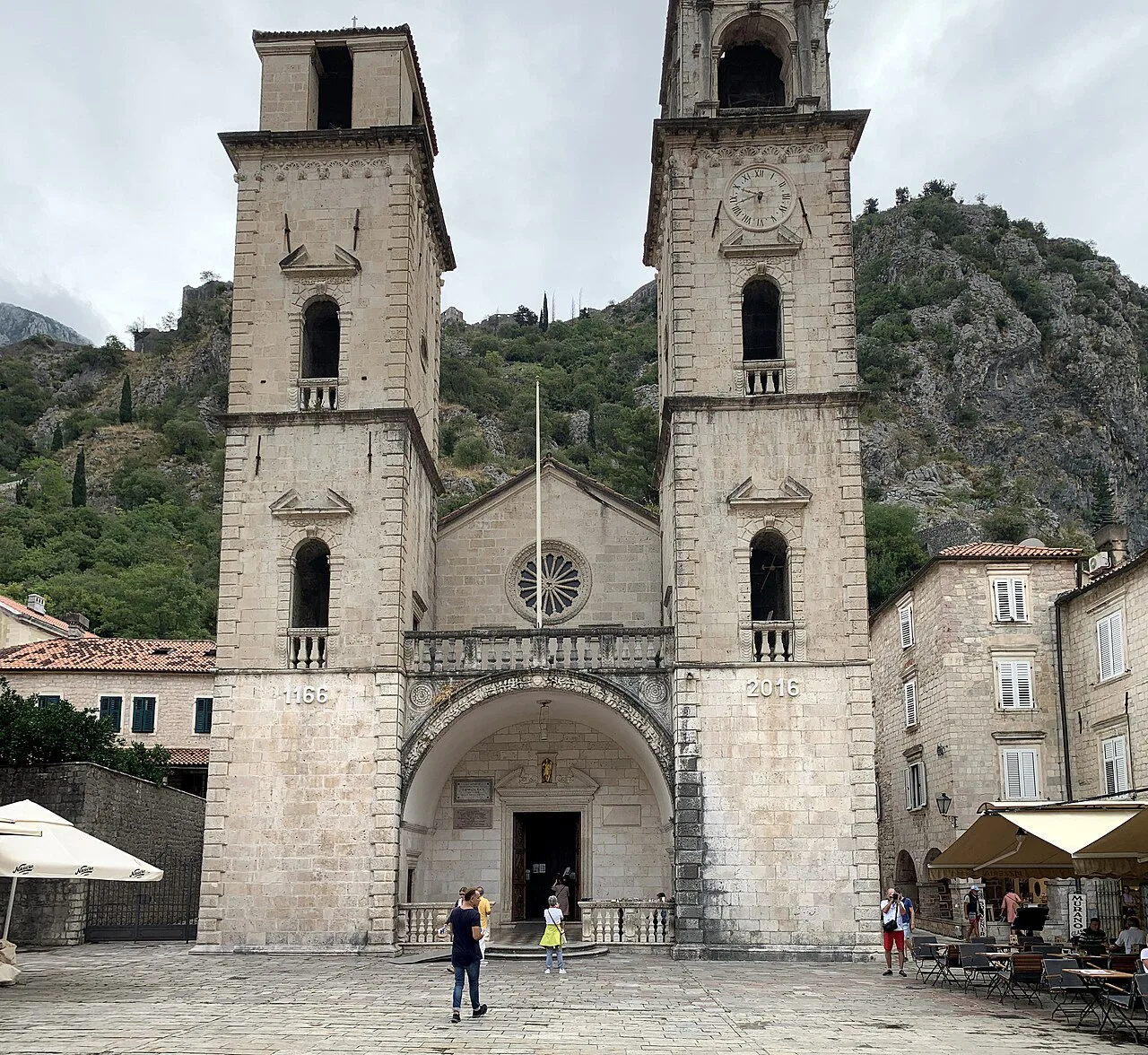
The cathedral faces Trg Sv. Tripuna in the heart of the walled old town, a few minutes' walk from the Sea Gate on the waterfront. Enter through the gate and follow the lanes through the old town; the square in front is small, so the building appears suddenly rather than as a grand set piece.
Everything in Kotor Old Town is pedestrian, and the cathedral is level ground from the gate, so no stairs are involved. If you are coming from the water, the lane route from the gate takes under five minutes at an easy pace. Toilets, cafés and the small food shops are outside the square rather than on it.

The façade and the two towers of different heights
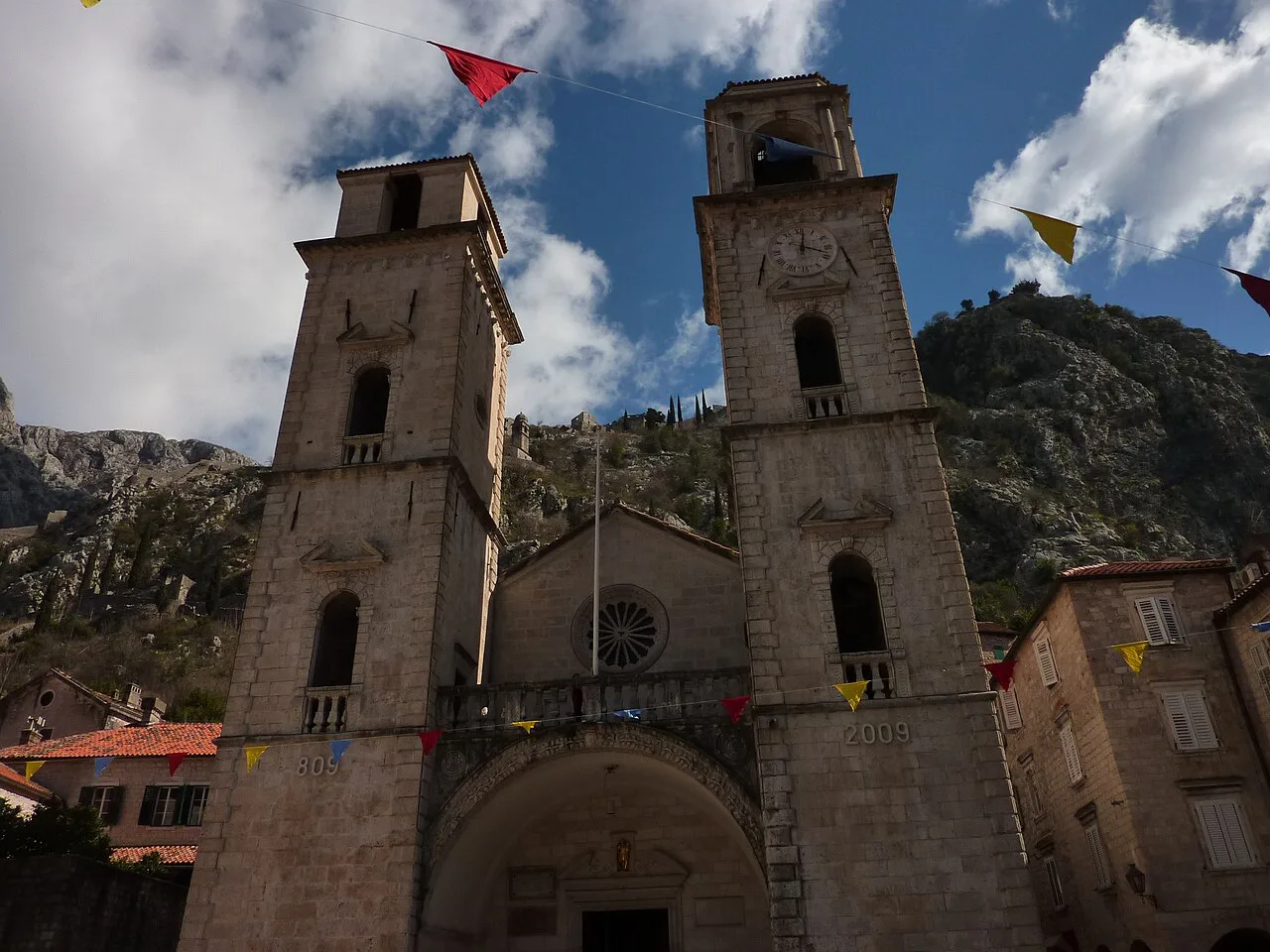
The most photographed quirk is that the northern bell tower is about two metres shorter than the southern one. The upper section of the north tower was never finished during the rebuilding that followed the 1667 earthquake, reportedly for want of funds. The result is a lopsided front that has become the cathedral's signature.
Look at the stone itself as well as the outline. The west façade is built of Korčula stone that takes on a warm colour in low evening light, which is why late afternoon is the better time to photograph it from the square. If you want the façade without a crowd of phones in front of it, go early in the morning before the tour groups build up.
Inside: the relic chapel and the sacral art museum
The single ticket covers the church, the relic chapel and the museum of sacral art. The treasury's centrepiece is a silver reliquary casket completed around 1539, whose figures of Saint Tryphon's executioners are shown in Turkish military dress, a reference to Ottoman pressure on the bay at the time. Silver figures made by John of Basel in 1440 are also held here.
Beyond the relics, the cathedral keeps a gilded altar, Baroque frescoes and a great number of valuable ornaments. Expect a compact museum rather than a national gallery: a couple of rooms of silverwork, vestments and documents take about 20 minutes if you read the labels.
Dress code and etiquette during a visit
This is an active church, not a museum with pews, and visitors are required to cover shoulders and knees. In summer that means no vests, strapless tops or short shorts; a light scarf or a shirt tied around the waist is enough. Hats off inside and quiet voices.
If a mass or the February Feast of Saint Tryphon procession is under way, wait outside or come back; the feast begins in late January and culminates on 3 February with a solemn mass and a procession of the relics. On ordinary days the atmosphere is calm and you can sit at the back without being moved on.
Tickets, payment and how long to allow
Entry is a modest fee, payable in cash, and it includes the relic chapel and the sacral art museum. Carry euros in small notes, because card machines are not part of the arrangement described. Ask at the desk what the current fee covers before you hand over money.
The cathedral publishes no fixed hours, so check the times posted at the door on the day you visit rather than planning around a web listing. A sensible allowance is 30 to 45 minutes for the church and chapel, or an hour with the museum. There is no need to book ahead.
Nearby churches and squares to pair with it
Two neighbouring churches make an easy add-on: St Nicholas, the main Orthodox church in the north of the old town, with a treasury of icons and vestments largely given by wealthy Kotor families, and the small church of Sveti Luka, built at the end of the twelfth century and used by both Catholic and Orthodox congregations at different periods. Both are within a few minutes' walk of the cathedral.
For a different kind of small museum, the Cats Museum, Kotor is in the old town and works well as a light break between churches. The Maritime Museum of Montenegro, Kotor covers the bay's seafaring history in a compact collection. Pair one of these with the cathedral and you have a comfortable half-day indoors.
If you have energy left, the walls and the Kotor Fortress climb above the town and take far longer than the cathedral; treat it as a separate visit with its own ticket. The old town itself rewards an unhurried walk after the cathedral, especially in the late afternoon when the day-trippers thin out.
The Sea Gate, Kotor is the natural exit back to the waterfront and its boats. The Clock Tower in Kotor stands just inside the old town near the gate and pairs neatly with a short wander around the squares.
Getting there from the waterfront and cruise terminal
Cruise ships dock on the water beside the old town, and the walk from the terminal to the Sea Gate takes a few minutes on the flat. From the gate it is a short, signposted route through the lanes to Trg Sv. Tripuna. On days when several ships are in, expect the square in front of the cathedral to be busy from mid-morning until early afternoon; visiting before that window is calmer.
If you arrive by bus, the station is a short walk from the old town walls, and taxis can drop you outside the Sea Gate because traffic cannot enter the lanes. Walking is the only way to reach the cathedral once you are inside the walls.
Should the cathedral be your first stop in Kotor?
Yes, if you want the old town's history in one compact visit: the Romanesque shell, the mismatched towers, the silver reliquary and a small treasury for one cash payment. Pair it with St Nicholas and Sveti Luka for the churches, and leave the fortress climb for another day.
Plan on 30 to 45 minutes inside, go early if a cruise ship is in port, and bring small euro notes. Check the times at the door on the day, and dress for a church rather than a beach.
Explore more Kotor guides
- Church of Our Lady of Remedy (Gospa od Zdravlja), Kotor
- Church of Saint Luke, Kotor
- Church of St Nicholas (Crkva Svetog Nikole), Kotor
- Drago Palace (Palata Drago) in Kotor's Old Town
- Grgurina Palace, Kotor
- Maritime Museum of Montenegro, Kotor
- Pima Palace (Palata Pima), Kotor
- Square of the Arms, Kotor
Frequently Asked Questions
Is St Tryphon's Cathedral worth visiting in Kotor?
It is the one building that explains why Kotor's old town is on the UNESCO list: a Romanesque core, a Gothic and Baroque overlay, the mismatched towers and a silver reliquary from around 1539. Thirty to forty-five minutes gets you the church, the relic chapel and the museum.
Do I need to book tickets for St Tryphon's Cathedral in advance?
No. Entry is paid in cash at the door, and the modest fee covers the church, relic chapel and sacral art museum. Check the times posted at the entrance on the day, because the cathedral does not publish fixed visitor hours online.
What should I wear to St Tryphon's Cathedral?
Cover both shoulders and knees, whatever the temperature outside; a light scarf works for a sleeveless top. Hats off inside and quiet voices.