
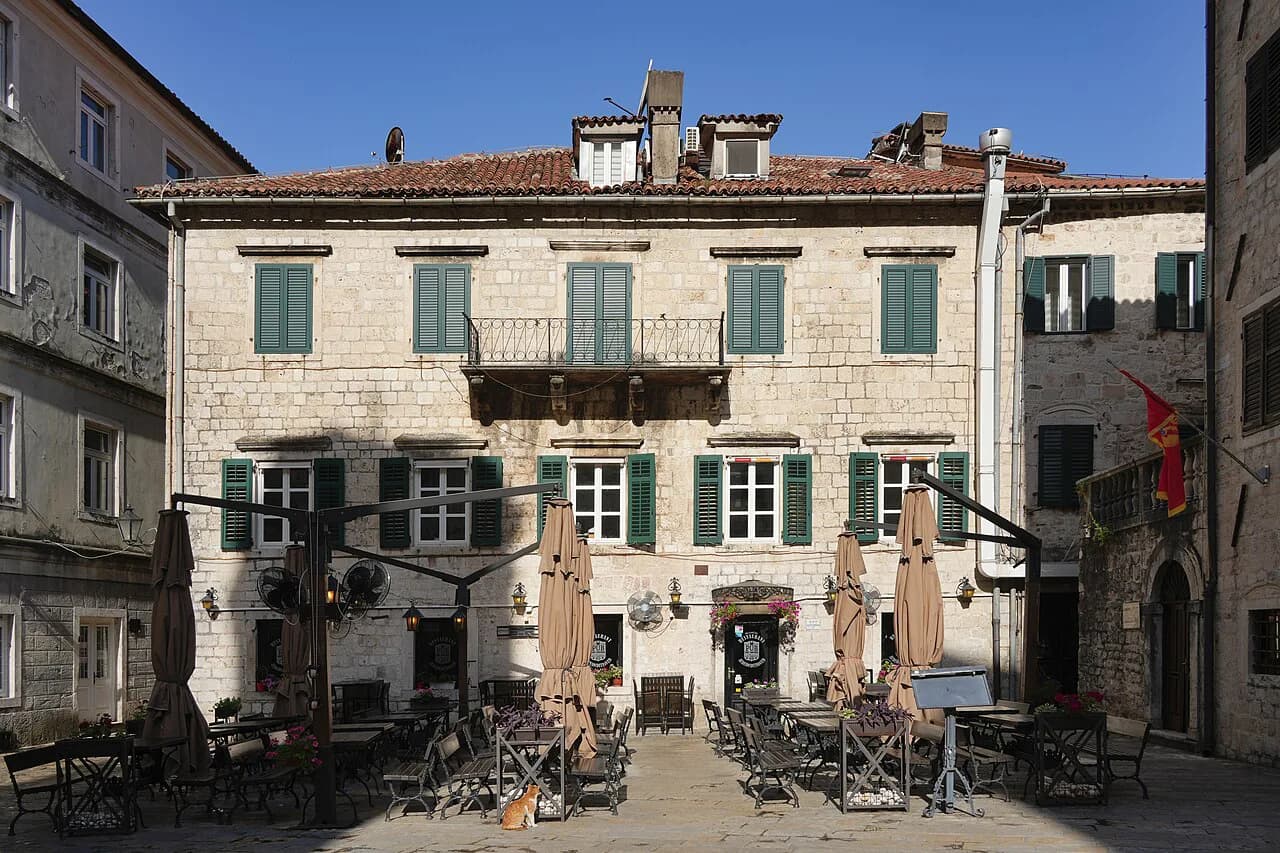
Square of the Arms, Kotor: the Old Town's Main Square

The Square of the Arms, Trg od oružja in Montenegrin, is the paved square you walk into immediately after passing through Kotor's Sea Gate. It is an open public space with no ticket, so you can cross it at any hour, and half an hour is enough to look at the Clock Tower, the Pillar of Shame and the palace facades before heading deeper into the Old Town.
This guide covers the square and the gate that leads onto it, then the individual buildings around the edge, the timing question of cruise-day crowds, and the sights within a few minutes' walk. Kotor's other attractions are covered separately in the wider Kotor attractions guide.
Where the square sits inside the Old Town
The square is the first space inside the Sea Gate, on the seaward edge of the walled town, and it opens directly off the gate passage. Because it is the main entrance, almost every walk through the Old Town begins or ends here, and it sits within a short walk of the cruise port. It is a long, narrow square rather than a broad piazza, so the buildings on either side are close enough to inspect properly without crossing the paving.
Treat the gate and square as one arrival sequence: you come through the vaulted passage, the light changes, and the Clock Tower is in front of you. If you are coming from the bus station or the harbour, the enclosed lanes are easy to lose your bearings in, so keep the town walls in view and aim for the Sea Gate rather than guessing at side lanes.
The Old Town is walled all the way round and has more than one entrance. Which one suits you depends on where you are approaching from; for a first visit the Sea Gate route gives you the square with the least navigation.
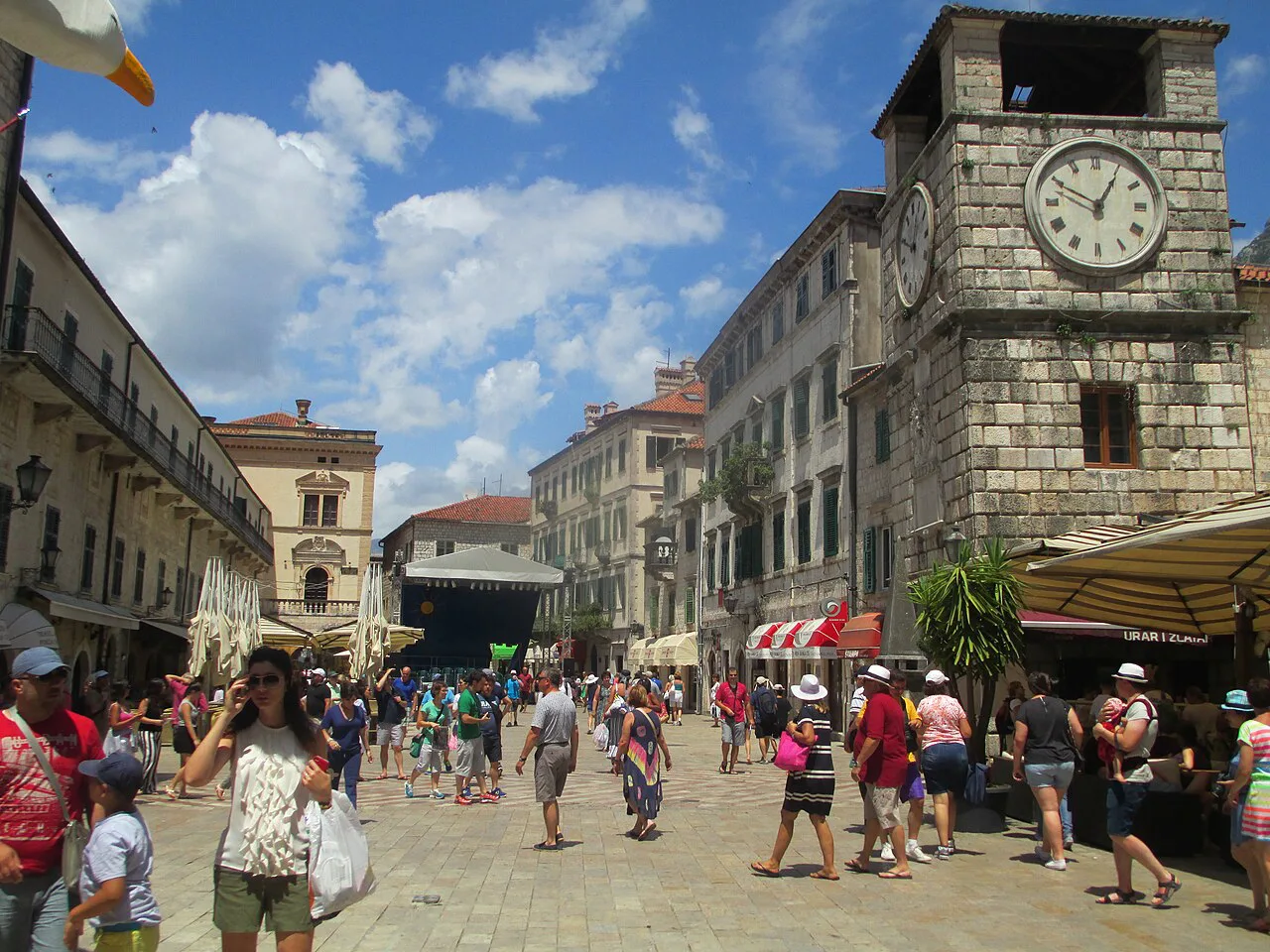

The Sea Gate itself
The Sea Gate was built in 1555 under Venetian rule, and its heavy Renaissance columns were designed to make an impression on anyone arriving by sea. Look up at the facade before you walk through: the winged Lion of Venice once stood here as the symbol of the republic, and the carvings were later replaced with socialist heraldry after the city's liberation on 21 November 1944. Beneath the Yugoslav emblem's six torches runs an inscription attributed to Josip Broz Tito: what belongs to others we do not want, what is ours we will never surrender.
The detail most visitors miss is inside the passage, where a carved 15th-century stone relief of the Virgin Mary with Jesus, flanked by Saint Tryphon and Saint Bernard, has survived in the vaulting. Pause in the shade and let your eyes adjust; it is easy to walk straight past. Saint Tryphon is the town's patron, and his cathedral a few lanes away is worth pairing with the gate.
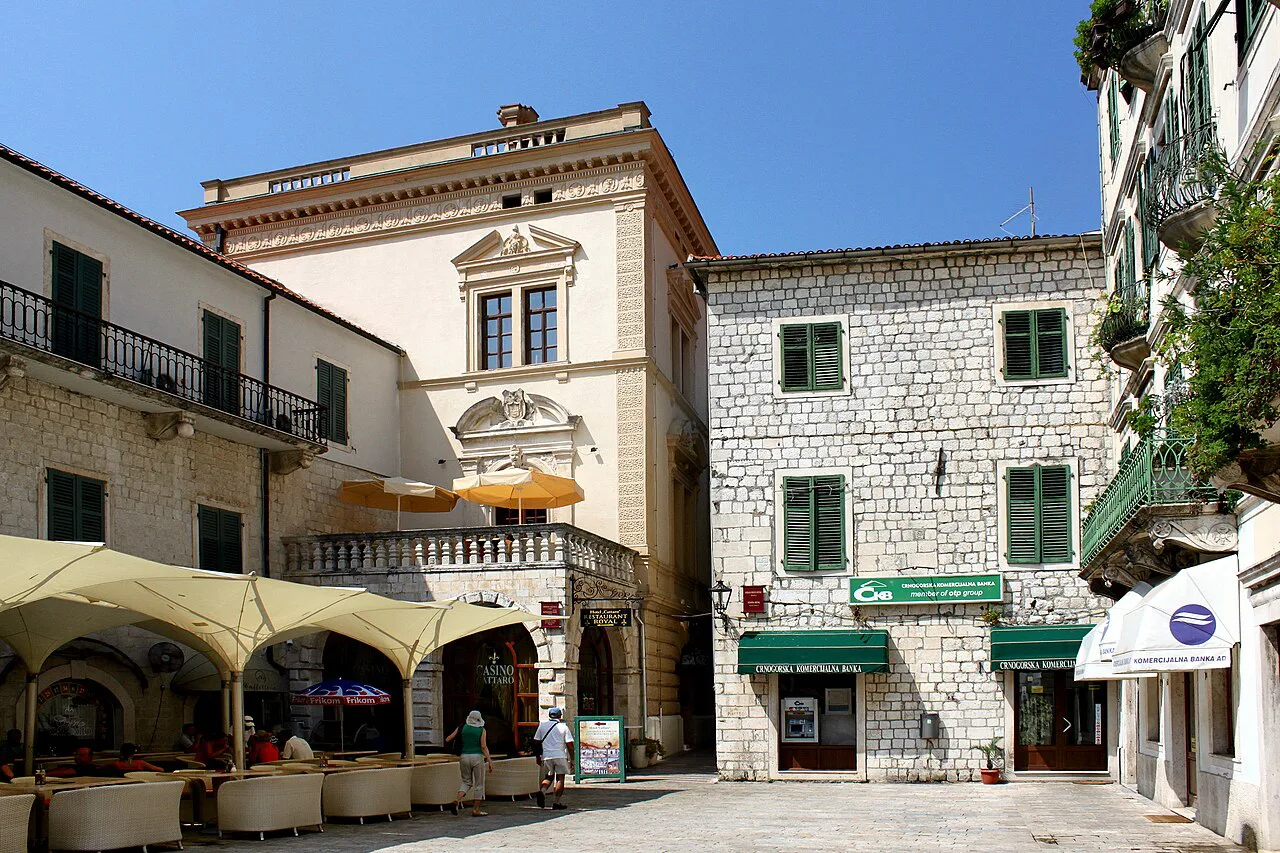

The Clock Tower and the Pillar of Shame
The Clock Tower, built in 1602, anchors the square with two working clock faces that chime on the hour. It is a Renaissance and Baroque structure that has come through repeated earthquakes, and it is the obvious meeting point if your group splits up. Stand on the square a few minutes before the hour if you want to hear it.
Directly in front of the tower stands a small pyramid-shaped stone obelisk known as the Pillar of Shame, where public sentences were announced and wrongdoers were put on display. It is a modest piece of stone and easy to overlook, but it explains the open space in front of the tower better than any plaque. Look for it at ground level rather than at eye height.
Palaces and buildings around the edge
The Rector's Palace, once the seat of the Venetian governors, now houses part of the Boutique Hotel Cattaro, so you see the exterior rather than wandering the state rooms. Napoleon's Theatre, an 18th-century building converted into a theatre in 1810, is another facade to pick out as you walk the length of the square. Neither is a museum stop in the usual sense, so budget your indoor time elsewhere.
At the north-west corner, the Kampana Tower forms one of the most recognisable stretches of the town walls, and it links the square to the fortifications climbing the hill behind. If you plan to walk any part of the walls, start by finding the tower so you know where the ascent begins. The walls themselves are a separate outing with their own access arrangements.
For indoor sightseeing close to the square, the Maritime Museum of Montenegro and the small Cats Museum are both a short walk into the lanes. Both keep their own opening hours and charge their own admission, so check before setting out rather than assuming they are open when the square is busy.
When the square is busiest
The square is the first thing cruise passengers see, and it is where most guided walking tours assemble, so it fills quickly when a ship is in. The trade-off is straightforward: mid-morning on a port day gives you the liveliest café terraces and the worst photographs, while an early start or a late afternoon gives you the paving almost to yourself. Ship schedules shift, so check the port's listings for the day you plan to be there rather than relying on a pattern.
If you want the square quiet, use it as a pass-through at peak times and come back later; the Clock Tower and gate are there whenever you return, and the lanes behind the square absorb crowds better than the open paving does.
The square also hosts seasonal events, including a Christmas market and carnival celebrations, but the years and dates change, so confirm locally if an event is your reason for visiting.
How long to allow and how to use it as a starting point
Give the square twenty to thirty minutes: enough to read the gate facade, find the relief in the passage, look at the Clock Tower and Pillar of Shame, and note the palace facades. Add time if you want a coffee at one of the terraces, which are the practical rest stop before or after a walk.
The limestone paving is smooth and uneven in places, and it holds heat in summer, so wear shoes with grip and carry water if you are continuing to the walls. There is little shade on the open square itself, though the gate passage and the café awnings offer relief.
Use the square as the start of a loop: gate, square, then the lanes towards St Tryphon's Cathedral and the museums, finishing back at the waterfront. That sequence keeps the busiest space at the beginning, when you are fresh, rather than at the end of a hot afternoon.
Guided walks leave from the square throughout the day, and self-guided audio tours cover the same ground if you prefer to move at your own pace. Either way, the square is the fixed point you return to when you get turned around in the lanes.
What's nearby in the Old Town
Walk a few minutes inland and you reach the lanes around the Pima Palace, a noble family house with a carved balcony. It is free to look at from outside and takes only minutes, so it fits neatly onto the end of a square visit.
St Tryphon's Cathedral, the town's patronal church, is a short walk from the square through the lanes, and its treasury and interior are the main indoor sight in the Old Town. Its opening arrangements vary by season, so check at the door or with the tourist office before planning your day around it.
If you have an appetite for more, the Kotor fortress walls and the wider set of things to do in Kotor fill out a full day beyond the square. The square is the anchor, not the whole visit.
Is the square worth more than a walk-through?
The Square of the Arms is free, open and unavoidable on any route through the Old Town, so the real question is how much time to give it. Treat it as a twenty-minute stop with a coffee, read the gate facade and find the relief inside the passage, then move on into the lanes.
Arrive early or late to dodge the tour groups, and check ship schedules and museum hours for your dates before you go. The square rewards a slower look, but it does not need a whole morning.
Explore more Kotor guides
Frequently Asked Questions
Is the Square of the Arms free to visit?
Yes. It is an open public square with no ticket and no gate, so you can walk through at any time. The buildings around it, such as the museums, set their own admission charges and hours.
How do I reach the square from the cruise port?
Walk from the port towards the town walls and enter through the Sea Gate; the square opens directly inside. The approach is short and signposted, and the gate passage is the obvious entry point.
What should I look at first on the square?
Look up at the Sea Gate facade before entering, then find the 15th-century relief in the vaulted passage. Inside, the 1602 Clock Tower and the Pillar of Shame in front of it are the two features to pick out.
Can I visit the square at night?
The square is open paving rather than a ticketed site, so you can cross it after dark, and the café terraces stay open into the evening. The Clock Tower is lit, but the gate passage is dim, so watch your footing.